Metabolomics approach reveals size-specific variations of black-footed abalone (Haliotis iris) in Chatham Islands, New Zealand
Nguyen TV, Alfaro AC, Venter L, Ericson JA, Ragg NLC, McCowan T, Mundy C. (2023). Metabolomics approach reveals size-specific variations of black-footed abalone (Haliotis iris) in Chatham Islands, New Zealand. Fisheries Research. https://doi.org/10.1016/j.fishres.2023.106645
Abstract
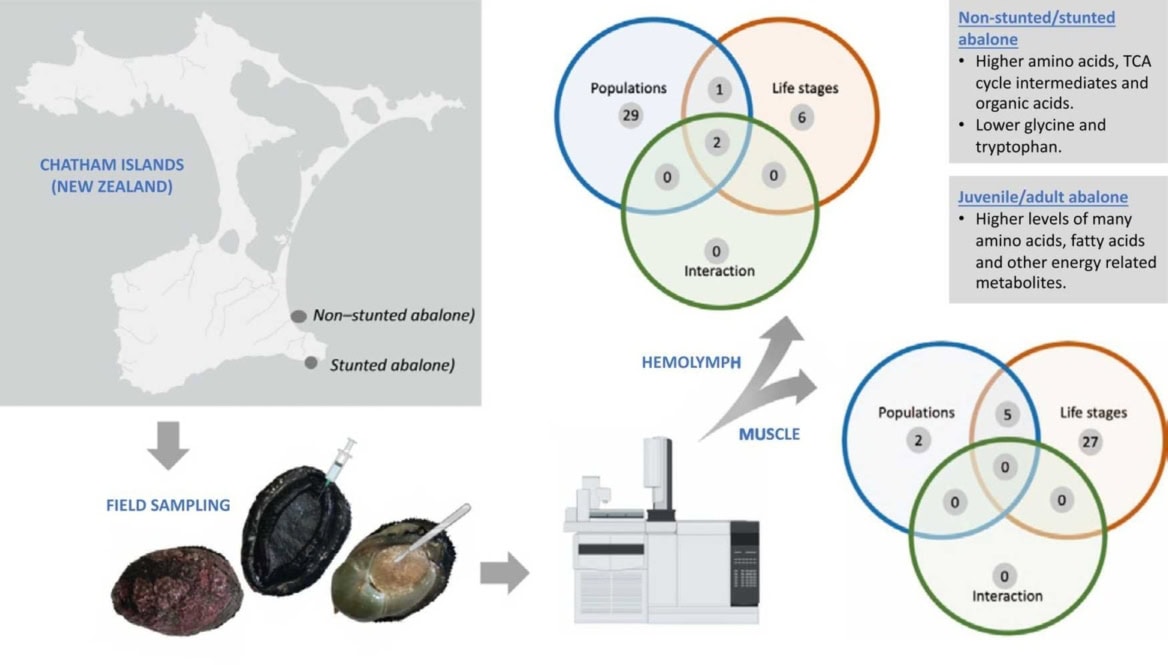
Broad phenotypic variation in shell morphology is a common phenomenon across wild abalone populations worldwide. Many shellfish species, such as abalone, show slower growth rates, smaller maximum size of individuals, and reduced biomass in some habitats compared to others. Such habitats are often inferred to be sub-optimal and, for a fishery, the shellfish within these sites are referred to as “stunted populations”. It has been suggested that these geographically-based variations are a function of environment, rather than genotypic in nature. For haliotid stocks, such as the New Zealand black-footed abalone (Haliotis iris), there is concern that environmental stressors many increase the proportion of stocks that are slow-growing, with potential flow-on effects for the fishery. Despite the relevance to fisheries, not much information is known about this growth phenomenon at the molecular level. Hence, this study was carried out to reveal insights into metabolic differences between non-stunted (fast-growing) and stunted (slow-growing) juvenile and adult abalone from two separated populations in the Chatham Islands, New Zealand, using a high throughput gas chromatography−mass spectrometry (GC−MS)-based metabolomics approach. The metabolite profiles revealed differences in many metabolites between juveniles and adults, which indicate higher levels of many amino acids, fatty acids and other energy-related metabolites in juveniles. Differences between stunted and non-stunted abalone populations mostly occurred in haemolymph of adults, which mainly included higher levels of amino acids, fatty acids and other organic acids in fast-growing abalone compared to slow-growing individuals. These differences may be due to distinct food and environmental conditions between these two sites. The findings from this study provide important insights into the origins of spatial variation in growth which will assist management strategies to ensure the sustainability of abalone populations and the fishery they sustain.
Keywords: Abalone; Stunting; Growth variations; Metabolomics; Haliotis iris; Abalone fishery